A transportation management system from load planning to freight close
Kargentra TMS is a transportation management system that takes transport demand from orders, the warehouse or measured freight, plans it into loads and trips, sources the carrier or private fleet and releases only what is ready. Every movement is supervised through execution and recovery, then closed to a Finance handoff on the same record.
What changes for your operation
Plans people can trust
The optimiser proposes and the planner accepts. An unknown rate or feasibility is shown as unknown, never as zero.
Award is not a booking
Award, tender, acceptance, booking and dispatch are separate states, so nobody mistakes a quote for a truck.
Release only what is ready
Each movement is Ready, Blocked or Approval needed, with the exact failing check and what changed since.
Close with evidence
Delivered movements move from evidence to Billing ready to Finance handoff, with every blocker named.
What TMS does
Plan, source, dispatch, supervise and close every movement
Transport Command
Each transport role starts on one prioritised list of situations drawn from planning, sourcing, dispatch, execution and recovery.
- Views for planner, carrier manager, dispatcher, fleet coordinator and supervisor
- Reason, impact, owner and time evidence on every item
- Opens the exact permitted workflow, then returns to refreshed facts
Demand and shipment formation
Transport demand comes from commercial orders, staged warehouse handling units or directly measured freight, then forms shipments.
- Residual demand pool with planning eligibility
- Measured weight, handling units and cargo compatibility group
- Order holds respected before any shipment is formed
- EDI X12 204 load tenders arrive as transport orders
Load and route planning
Find residual freight, run the internal optimiser and compare up to three ranked alternatives before accepting or replanning.
- Compare distance, travel time, capacity, rate and eligibility
- What-if runs that write nothing
- Rate unknown and Feasibility unknown shown explicitly
- Version-checked acceptance and replanning, with history kept
Road routing and stop order
With the tenant's own maps provider keys, calculate road routes and propose a better stop order or a multi-vehicle plan.
- Proposals stay read-only until a planner approves them
- Metered budget with confirmation before billed calls
- Missing durations are never treated as zero
Carrier and fleet sourcing
Compare private fleet feasibility, contracted carrier baselines and genuine spot quotes for one movement without mixing price bases.
- Agreement status: in force, scheduled, expired, terminated
- RFQs with append-only quote versions
- Award an exact quote version with a recorded reason
Routing guide and tender recovery
A per-lane routing guide sets carrier order, a not-to-exceed cap and an attempt limit for every tender.
- Rejected or lapsed tender: next carrier by rule, or a hold with a named reason
- No carrier is re-offered the same tender
- Tenders queue: awaiting an answer, lapsing within a day, lapsed unanswered
Dispatch readiness and release
Every confirmed trip or fleet movement shows Ready, Blocked or Approval needed, with the exact failing checks.
- Documents, insurance, assignment, facility service and open exceptions
- What changed and What to do on every check
- Driver, tractor and trailer eligibility and assignment
- Version-checked release; driver acknowledgement stays separate
Execution and exception recovery
Supervise released movements by what needs a person first, and work each exception from cause to a verified recovery.
- Observed facts kept apart from the plan and the commitment
- Delivery risk, silent tracking, hours shortfall and route deviation open cases
- Replace driver, vehicle or carrier with hours-of-service feasibility
Delivery and Commercial Close
Each delivered movement sits at one stage, from delivery evidence incomplete to Handed off to Finance.
- Exact billing blockers in the owner's own wording
- Sell, expected buy, actual cost, accessorials, variance and margin kept distinct
- Immutable Finance handoff id; TMS posts no accounting entries
Route optimisation that explains every refusal
Planners find residual freight, run the optimiser and compare ranked alternatives on distance, travel time, capacity, rate and eligibility. The optimiser returns a stop order; the platform re-derives schedule, utilisation and economics and refuses any plan that disagrees. A planner accepts, and the decision is versioned with its evidence.
- Recommendation only: the planner accepts or revises
- Fits, Over capacity, Rate unknown and Feasibility unknown as explicit states
- A private-fleet shortlist that never offers a driver without confirmed hours
- Ask Kargentra explains the options and the checks to run before acceptance

A tender waterfall that follows your routing guide
Once a provider is chosen, the tender goes out at a frozen price with an answer-by deadline. If the carrier declines or lets it lapse, the routing guide picks the next qualified carrier or holds with a named reason. Award, tender, acceptance and booking stay separate, so the board always tells the truth about capacity.
- Private fleet, contracted and spot pathways compared for the same movement
- Every award carries a buyer reason, kept in the audit trail
- Named holds: guide exhausted, not-to-exceed exceeded, no qualified carrier
- Carriers answer in their own portal, and the answer lands on the tender
Release what is ready, then supervise what moves
The dispatcher resolves exact readiness blockers and releases with a version check. From there, Live Execution groups every released movement by what needs a person first. Field milestones remain owned by the driver and the carrier: the board shows what was observed and never invents a lifecycle state.
- Groups: Exception open, Stopped progressing, Released not started, Moving now
- Release is version-checked, so a stale screen cannot release an outdated plan
- Freshness on every movement: recently observed, not observed recently, never observed
- One step to the dispatch decision, delivery result, recovery and commercial close

One movement, from transport demand to Finance handoff
- 01
Form demand
Orders, staged handling units or measured freight enter the demand pool with their planning eligibility. Owner: transport planner.
- 02
Plan the trip
Shipments are consolidated into a load and a trip. The optimiser proposes; the planner accepts a version and the trip is created.
- 03
Source and award
Private fleet, contracted or spot. The carrier manager awards an exact quote version with a reason. Award is not a booking.
- 04
Tender and book
The tender is offered at a frozen price. The carrier accepts in its portal and the booking is confirmed, or the routing guide moves on.
- 05
Assign and evaluate readiness
Driver, tractor and trailer are assigned. Readiness checks documents, insurance, facility service and exceptions: Ready, Blocked or Approval needed.
- 06
Release
The dispatcher releases with a version check. Released is not acknowledged and not picked up; those facts belong to the driver and carrier.
- 07
Execute and recover
Positions and stop events are observed. Detected risks open owned exception cases until the condition is verified clear. Owner: transport supervisor.
- 08
Close and hand off
Evidence complete, then Billing ready, Closeout approved and Handed off to Finance, with an immutable handoff id.
Inside Transportation Management
Captured from the running Kargentra application. Data shown is demonstration data.
- app.kargentra.com/transportation/sourcing
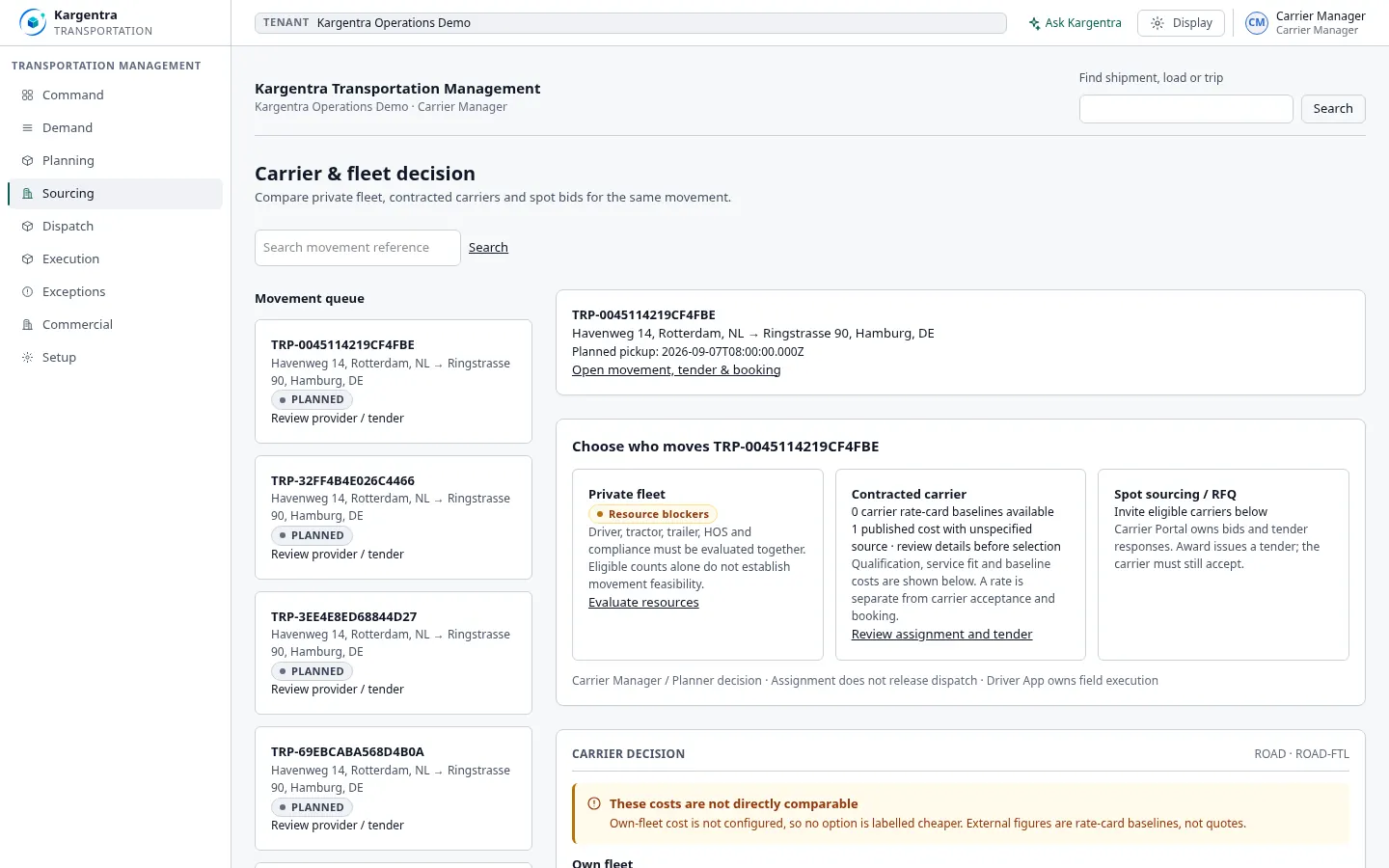
Sourcing · Carrier and fleet decision for one movement - app.kargentra.com/shipments
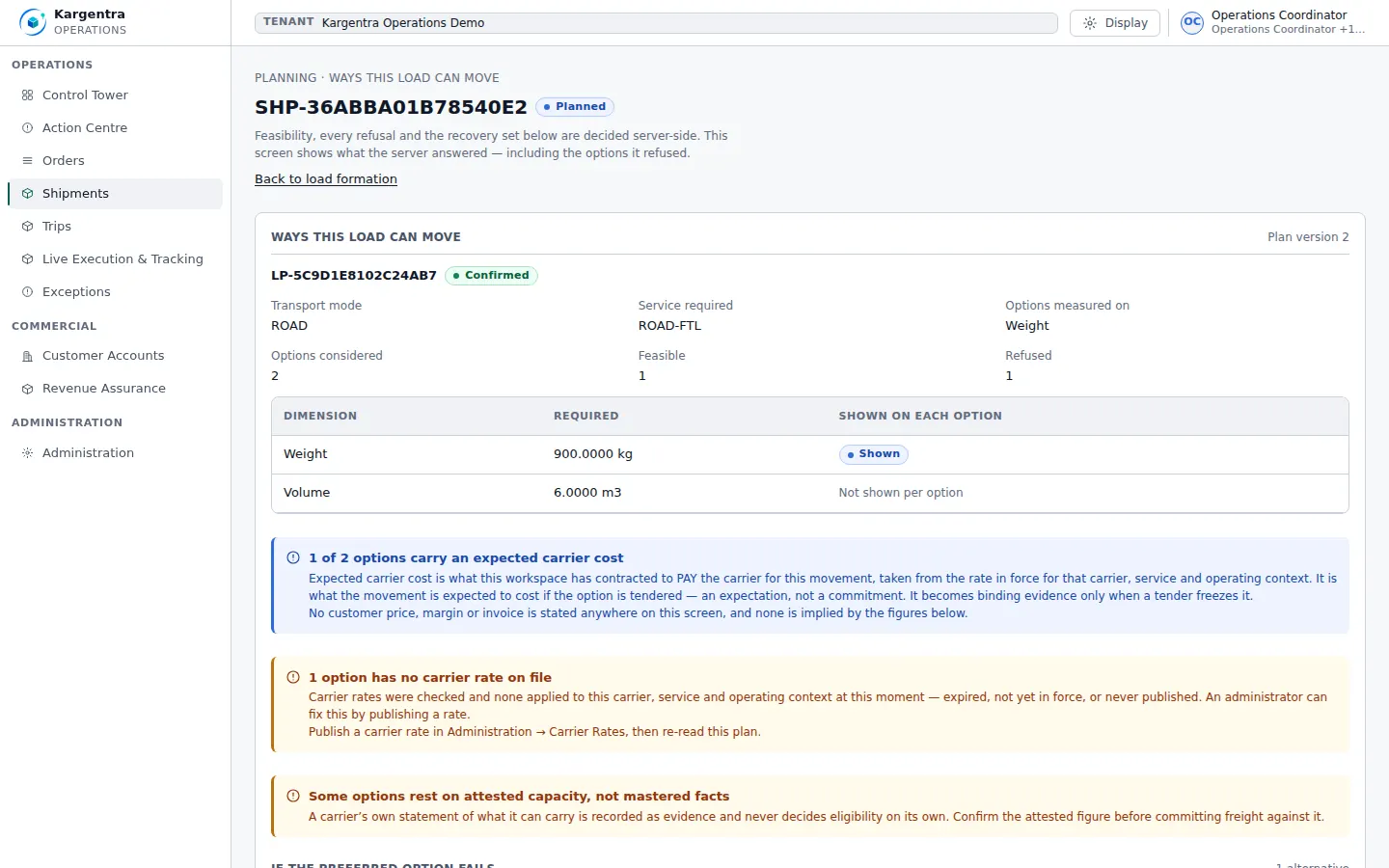
Load formation · options considered, feasible and refused, each with its reason - app.kargentra.com/transportation/sourcing
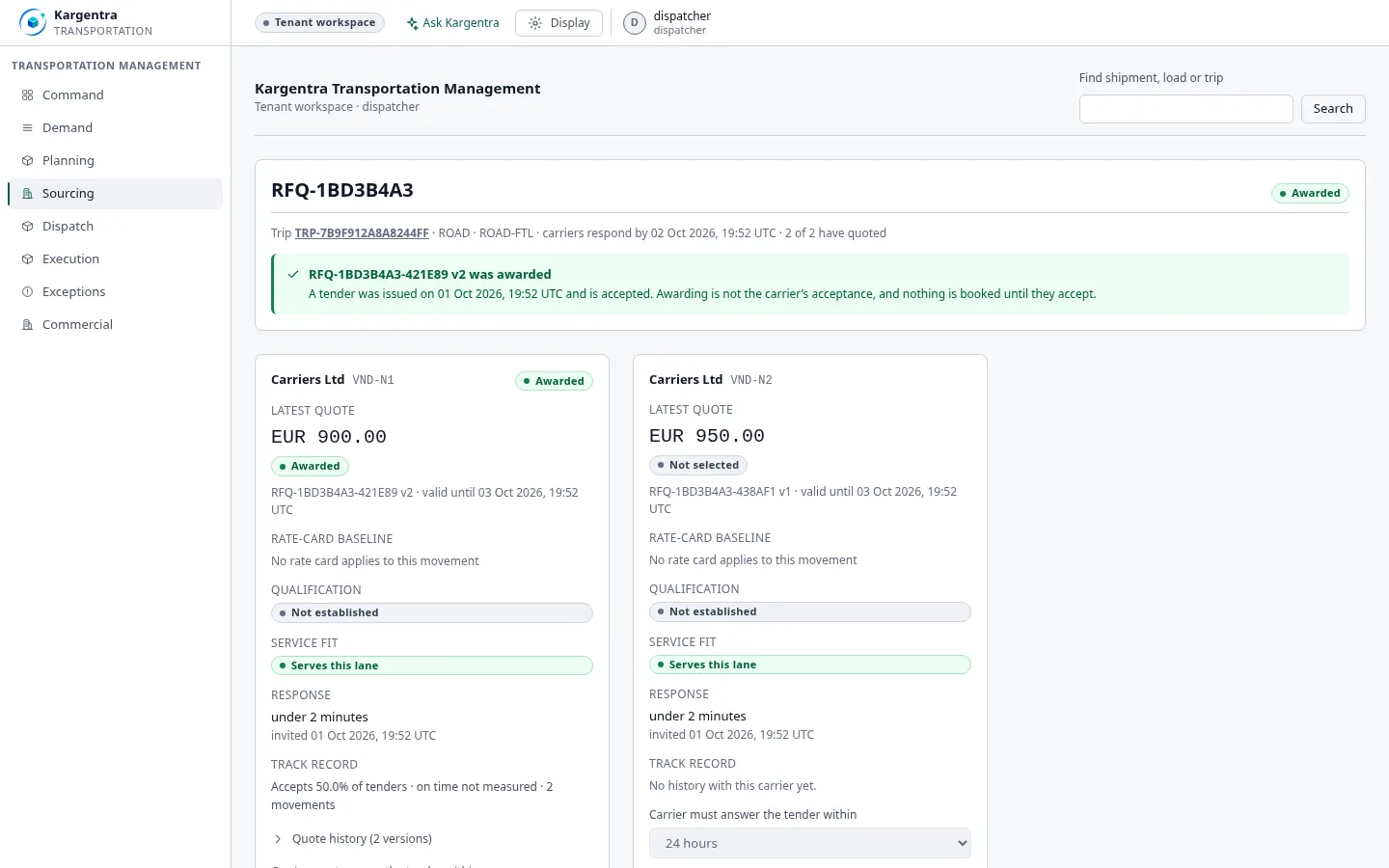
Spot quotes · compare carrier bids and award - app.kargentra.com/transportation/setup
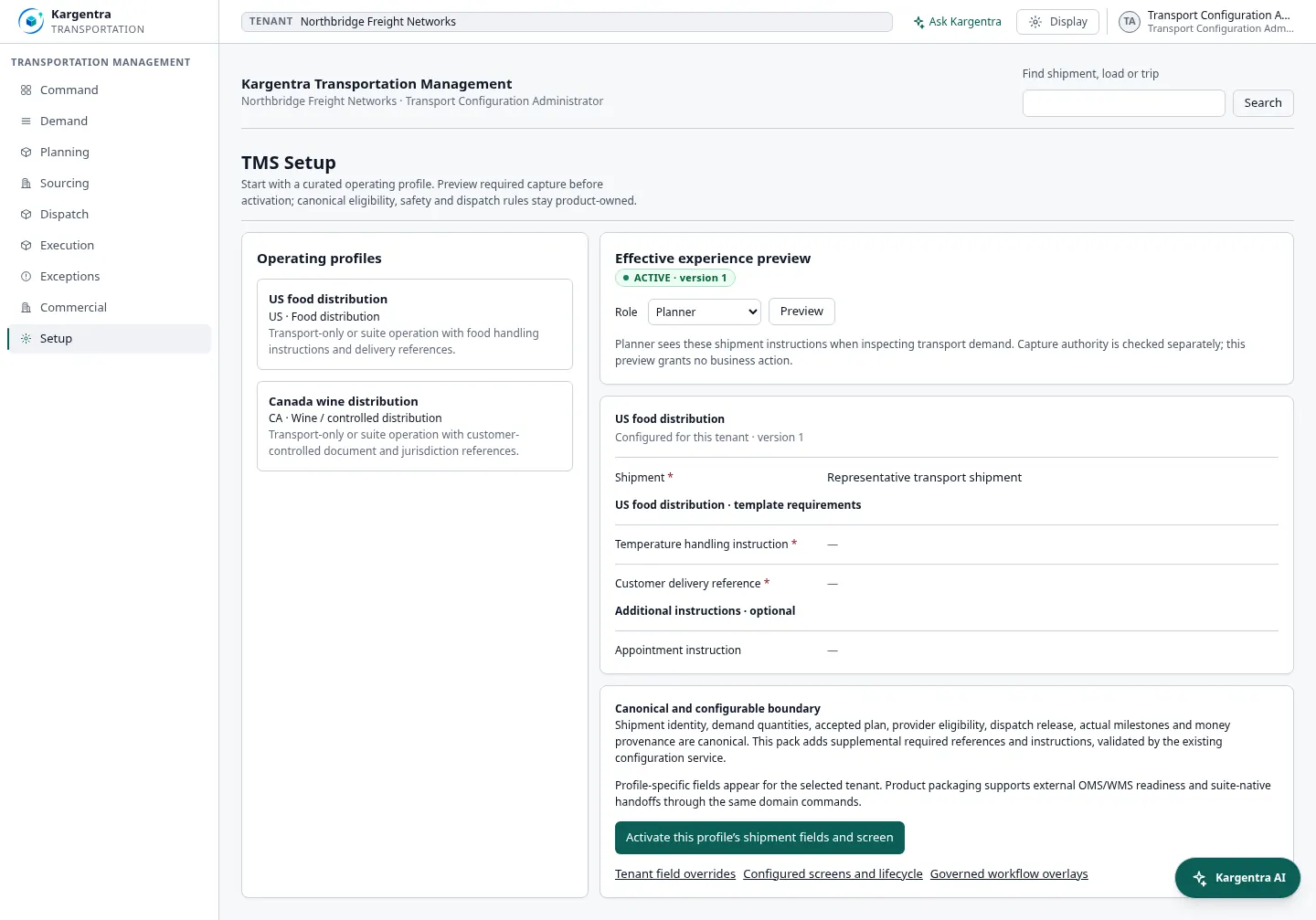
TMS setup · operating profiles with effective policy and history


Governed AI inside TMS
Ask Kargentra reads the record you are looking at, cites every fact it uses and proposes the next step. Nothing changes until a person with the right permission approves it.
- Explain these options
- Checks before acceptance
- Why is the Rotterdam stop unpriced?
Option B consolidates four shipments into one trip of 412 km, against 468 km for the two direct runs, and it fits the trailer by weight and floor space. The Rotterdam stop has no contracted rate on that lane, so the comparison shows the rate as unknown rather than zero. One driver is excluded from the shortlist because their duty hours are not confirmed.
- Plan comparison · Option B · distance change
- Capacity · Fits · weight and floor space
- Rate · unknown · lane NL-RTM
- Hours of service · not confirmed · driver excluded
Proposal · requires approval
Accept Option B for these four shipments and create trip TRIP-4410, then source the Rotterdam leg by spot RFQ.
Approver: Transport planner. Applied only through the governed action, and recorded in the audit trail.
Exceptions and edge cases TMS handles
Real operations are mostly exceptions. These are handled as first-class states with an owner, evidence and a next step, not as notes in a spreadsheet.
- A carrier declines a tender an hour before the deadline: the routing guide offers the next qualified carrier or holds with a named reason.
- The cheapest plan needs a driver whose duty hours are not confirmed: that combination is never offered as executable.
- A lane has no contracted rate: the comparison shows Rate unknown instead of pricing the option at zero.
- Freight changes after the Bill of Lading was issued: the document is flagged stale and a new version needs acknowledgement.
- A planner runs a what-if during a live day: it writes nothing, so the board and the accepted plan stay exactly as they were.
- A delivery is partial: the variance needs a recovery with a reason code before the movement can close.
- The next carrier in the guide would breach the not-to-exceed cap: the tender holds rather than overspending.
- Two planners revise the same movement: acceptance is version-checked, so a stale screen cannot overwrite a newer plan.
Who uses TMS
Transport planner
Forms shipments, runs and compares plans, accepts or replans a movement, and asks Kargentra to explain the options before deciding.
Carrier manager
Maintains carrier agreements and routing guides, runs RFQs, awards exact quotes with a reason and watches tender response.
Dispatcher
Resolves readiness blockers, assigns eligible resources and releases ready movements with a version check.
Fleet coordinator
Matches drivers, tractors and trailers to movements with hours-of-service feasibility and keeps fleet movements unblocked.
Transport supervisor
Supervises live execution, owns exception cases and verifies that each recovery actually cleared the condition.
Transportation manager
Reads Manager Health for the transport operation and opens the exact records behind any figure that moves.
Transportation Management at a glance
A scannable reference for evaluation teams and RFPs.
| Planning |
|
|---|---|
| Sourcing and tendering |
|
| Dispatch |
|
| Execution and recovery |
|
| Close and measure |
|
| Setup and deployment |
|
| Integrations |
|
Connected to the rest of Kargentra
Every module reads and writes the same record, so a hand-off is a state change rather than a re-keyed file.
- Order ManagementAccepted orders become transport demand, and hold, promise and transport state stay linked on the order.Explore OMS
- Warehouse ManagementStaged handling units feed measured demand, and Warehouse ready is a readiness check before release.Explore WMS
- Carrier Network & PortalCarriers answer tenders, quote, nominate driver, tractor and trailer, and upload delivery evidence in their own portal.Explore Carrier
- Driver AppDrivers acknowledge work and record arrival, service, delivery attempts and POD; those facts flow back to execution.Explore Driver
- Control Tower & Live TrackingReleased movements, positions, ETA risk and exception cases are supervised from the Control Tower.Explore Control Tower
- Freight Finance & BillingThe Finance handoff carries sell, expected buy, actual cost and accessorials into freight audit and invoicing.Explore Finance
TMS: frequently asked questions
What does a transportation management system do?
A transportation management system plans freight into loads and trips, chooses the carrier or private fleet, tenders and books capacity, releases movements to execution, supervises them and closes them commercially. Kargentra TMS runs every one of those steps on the same movement record, ending in a Finance handoff, so planning, dispatch, tracking and billing never disagree about what happened.
How does load and route optimisation work in Kargentra?
Planners select residual freight and run the internal optimiser, built on OR-Tools, which compares up to three ranked alternatives on distance, travel time, capacity, rate and eligibility. The optimiser returns a stop order, and the platform re-derives schedule, utilisation and economics before showing the plan. Nothing is committed until a planner accepts it, and what-if runs write nothing at all.
Does Kargentra TMS accept EDI 204 load tenders?
Yes. Kargentra receives X12 004010 204 load tenders from registered trading partners and turns each into a transport order, keeping the raw file, parsed segments and control numbers as evidence. Failures are classified with a plain next action and can be replayed once fixed. Tendering out to carriers runs through the carrier portal with an answer-by deadline and routing guide recovery.
How are delivery exceptions handled?
Background checks detect delivery risk, silent tracking, insufficient driver hours, route deviation, missing POD and partial-delivery variance, and each opens a case with an owner. The supervisor sees cause, evidence and customer-promise impact, chooses a permitted recovery such as replacing the driver, vehicle or carrier, and records whether it worked. A recorded attempt is never treated as a fix.
Can we run Kargentra TMS on its own?
Yes. A tenant can run TMS only, or connected with Kargentra OMS and WMS. One effective-availability decision governs the API, navigation and preview, and each stage can be native, external or hybrid. Demand can arrive by API, Connector Hub, EDI 204 or manual entry, and execution can use external carriers, a private fleet or both.
How long does a TMS implementation take?
It depends on your lanes, carriers and integrations, so we scope it with you rather than quote a number. Implementation starts from a curated operating profile for your region and industry, which you preview before activation. Guided readiness checks show what is still missing, and API, Connector Hub and EDI intake can be switched on one source at a time.
Further reading
- Guide · 10 min readWhat is a transportation management system (TMS)?What a TMS does, how it works from transport demand to freight audit and billing, who uses one and how to evaluate it without being sold a map.
- Guide · 9 min readWhat is a logistics control tower?What a logistics control tower does, how it differs from a visibility platform, the data it needs and the KPIs that survive scrutiny.
- Guide · 9 min readFreight audit and billing readiness, explainedThe freight audit process step by step, why delivery evidence decides billing readiness, common invoice errors and how disputes are resolved.
Take the TMS datasheet with you
Capabilities, workflow, capability reference and the questions buyers ask, on two pages.
PDF · 2 pages · 362 KB
See Kargentra run your operation
A working session on your lanes, your sites and your hand-offs: order to invoice, on one record.